
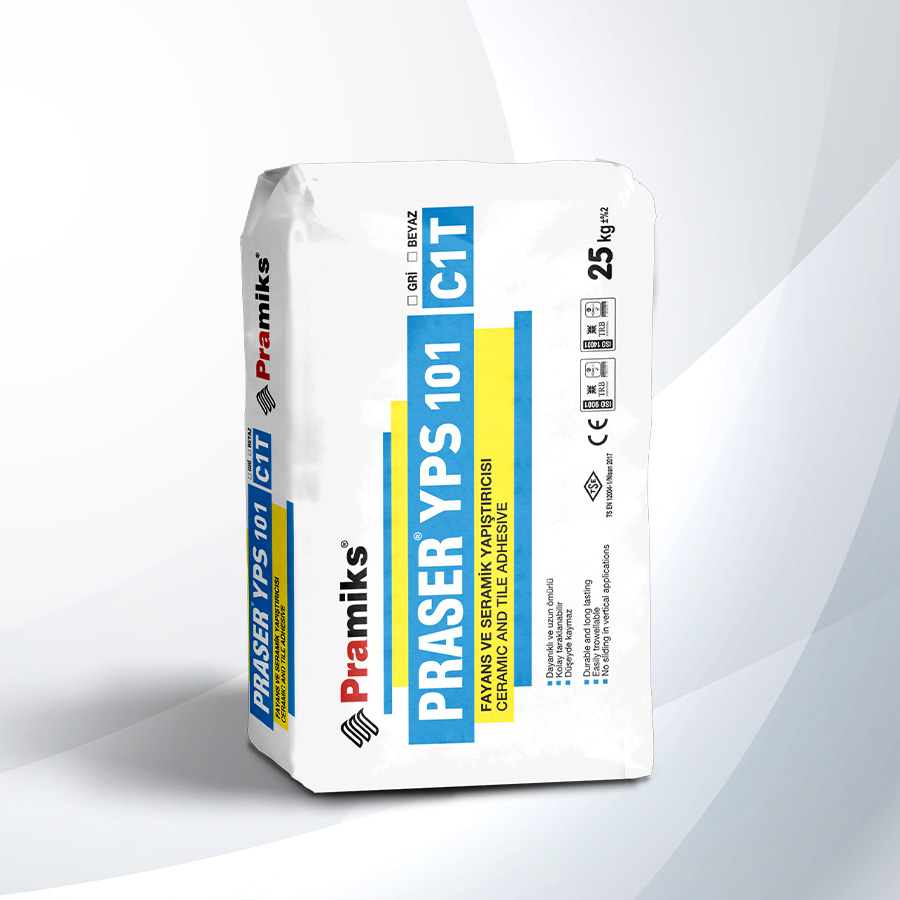
PRASER® YPS101 C1T Seramik Fayans ve Karo Yapıştırıcı
Seramik Fayans ve Karo Yapıştırıcı
₺66.00
It is a grey and white cement-based, polymer-modified, reduced-slip ready-mix adhesive mortar used for bonding tiles, ceramics, and similar cladding materials on horizontal and vertical surfaces of interior and exterior areas such as concrete, screed, and plaster.
Easy and fast to apply.
Suitable for cladding materials with both low and high water absorption.
Offers ideal mechanical strength.
Ease of Application:
• Easier to spread and apply.
• Shows less tendency to slip, which helps the ceramics stay in place.
• Suitable for use on walls and floors.
High Performance:
• Provides high bonding strength.
• Can be used for both low and high water absorption ceramics.
• Resistant to freeze-thaw cycles.
• Has ideal mechanical strength.
Economical:
• Can cover more area with less material usage.
• More economical due to lower waste production.
On Walls: Suitable for installing ceramic tiles, wall tiles, and mosaics in bathrooms, kitchens, and other wall surfaces.
On Floors: Can be used for floor tiling in bathrooms, kitchens, corridors, and hotel lobbies.
Exterior Claddings: Applicable for ceramic tile and mosaic installations on building facades.
Stair Claddings: Suitable for tiling ceramic tiles and mosaics on both indoor and outdoor stairs.
Floor Coverings: Ideal for ceramic tile and mosaic installations in commercial spaces such as offices, shops, and restaurants.
Cleaning: The surface to be applied must be cleaned first. All dirt, oil, dust, and other foreign materials on the surface should be removed. Suitable cleaning materials and water can be used for this process.
Smoothness Control: It should be checked whether the surface is smooth. If there are cracks, holes, or other defects on the surface, these should be repaired beforehand. If necessary, corrective filler materials can be used.
Primer Use for Absorbent Surfaces: If the surface to be applied has an absorbent structure, primer may need to be used. Primer reduces the absorbency of the surface, allowing the adhesive to spread evenly and increasing the bonding strength.
Plumbing and Electrical Installation Control: If there are plumbing or electrical installations under the area to be applied, they should be checked, and protective measures should be taken if necessary.
Control of Surface Moisture Content: The moisture content of the surface should be checked. A surface that is too wet or too dry can hinder the effective performance of the adhesive. If necessary, moisture level should be checked using moisture measurement devices.
Wet the Surface Before Adhesive Application: Especially on absorbent surfaces, the surface may need to be lightly moistened before applying the adhesive. This helps the adhesive spread evenly and increases the bonding strength.
• Approximately 6.00 / 6.50 liters of water should be added to 25 kg of powder, and mixed thoroughly with a low-speed mixer until no lumps remain. (The adhesive mortar used for outdoor applications should contain less liquid compared to the one used for indoor applications. This ensures that the mortar has greater flexibility.)
• After the mortar has been matured for about 5 minutes, it should be mixed for another 1-2 minutes before application.
• The mortar should be applied to the surface and its thickness should be adjusted using a toothed steel trowel. The size of the trowel teeth should be selected based on the size of the ceramic to be laid and the smoothness of the surface to be applied.
• The adhesive should be spread evenly over the surface with a trowel. The adhesive thickness should vary based on the size of the covering material. For small-sized materials, the adhesive should be applied with a thickness of 3-5 mm, and for large-sized materials, it should be applied with a thickness of 5-10 mm.
• The covering materials should be placed on top of the adhesive. The materials should be carefully positioned on the adhesive. After the materials are properly placed, they should be gently tapped into place. To ensure good adhesion, force should be applied using a rubber mallet to expel the air.
• The covering materials should be moisturized with water for 24 hours. This process ensures the complete curing of both the covering materials and the adhesive.
• It is recommended to apply the product at temperatures between +5 °C and +35 °C.
• It should be protected from fast drying in windy conditions.
• It should not be applied to frozen surfaces.
• It should not be applied under direct sunlight.
• No foreign materials should be added to the prepared mortar.
• Mortar that has exceeded its usage time should not be mixed with water or dry mortar and reused.
• The curing process should be completed, as the adhesive may not reach its maximum strength without full curing.
• All tools used should be washed with water before drying.
• To protect from adhesive dust and chemicals, use gloves, protective goggles, and a mask.
• Good ventilation is required in the workspace to prevent inhalation of chemical vapors during adhesive application in closed areas.
• It is important to clean hands and skin immediately after contact with the adhesive.